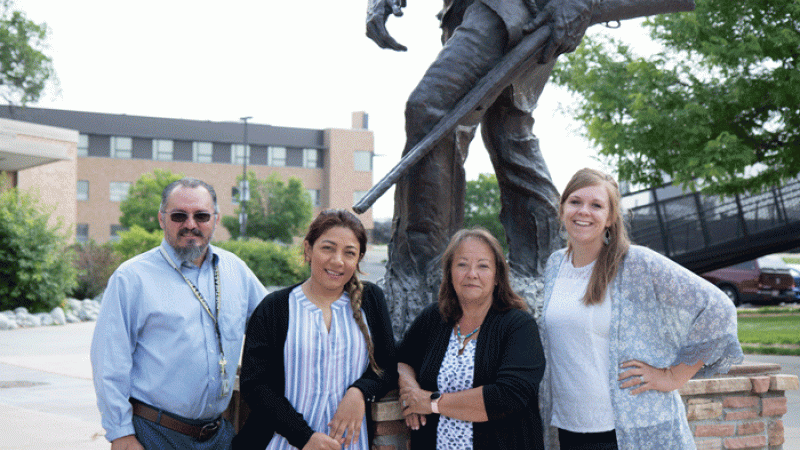
Providing assistance and accommodations to support student success.
In compliance with the Americans with Disabilities Act (ADA) and Section 504 of the Rehabilitation Act, the Monahan Learning Center (MLC), coordinates Northeastern's efforts to provide full access to educational, cultural and other programs sponsored by the college for any qualified student with a disability.
Northeastern is committed to providing services to assure an accessible environment for students with disabilities. The transition specialist, whose office is located in the MLC, will discuss concerns about disabilities and approve and coordinate academic accommodations for all qualified students.
Student Rights and Responsibilities
In addition to providing notification and documenting the need for accommodation(s), students with disabilities also have the following rights and responsibilities:
Student Rights
- To an equal opportunity to participate in and benefit from courses, programs, services or activities offered through the college.
- To an equal opportunity to work and to learn, to receive reasonable accommodations, academic adjustments and/or auxiliary aids and services.
- To expect all disability-related information to be treated as confidential and the assurance that all disability-related records are maintained separately from college records except as disclosed and required by law.
- To receive appropriate accommodations in a timely manner.
Student Responsibilities
- To self-identify as an individual with a disability and provide current documentation of a disability to the transition specialist in the MLC.
- To meet qualifications and maintain essential institutional standards for courses, programs, services or activities.
- To initiate all requests for accommodations and services and to request accommodations at the beginning of each semester.
- To maintain clear and open communication with instructors and the transition specialist.
- To meet academic standards required for admission or participation in any educational program, as well as adhere to Northeastern's student code of conduct.
- To contact the transition specialist if reasonable accommodations are not implemented in a timely manner.
Processes
New Students:
- Contact Us and Request: To schedule an appointment, call or email us at 970-521-6727 or eryn.fricks@njc.edu. We recommend contacting us at least 4 weeks before the semester beginning, but we will gladly work with you throughout the entire semester.
- Engage in the Interactive Process: Meet with our Transition Specialist. Discuss the disability-related circumstances that impact your learning and how we can support you. Provide documentation of your disabilities.
- Self-Advocate: Discuss your accommodations with your instructors. Utilize NJC's academic and student support services, like tutoring and counseling.
Returning Students:
- Have questions, updates, or changes to request? Call us at 970-521-6727 email us at eryn.fricks@njc.edu to schedule an appointment.
- No questions, updates, or requested changes? Stop by the MLC to pick up your letter at the start of each semester.
Grievance Procedure
If you disagree with a decision regarding your request for accommodations, you have the right to file a grievance. We are committed to a fair and respectful process to resolve concerns. Here’s how to proceed:
Step 1: Informal Resolution (Recommended First Step)
- Contact: Accessibility Services at 970.521.6727 to schedule a meeting.
- Action: Discuss your concerns and provide additional documentation if needed.
- Goal: Resolve the disagreement informally.
- Timeline: Within 10 business days of the original decision.
Step 2: Formal Grievance
If the issue is not resolved informally, you may file a formal grievance.
How to File: Submit a written grievance form
This will form be submitted to the Accessibility Services committee for review.
Deadline: Within 20 business days of the original decision.
The Accessibility Services Committee will:
- Review your grievance and documentation
- Meet with involved parties
- Ensure policies are followed
Step 4 (Optional): External Appeal
If still unresolved, you may contact:
Office for Civil Rights (OCR), U.S. Department of Education
https://www.ed.gov/ocr